Pressure testing under
real-world operating conditions
Custom testing systems for evaluating the load-bearing capacity, safety, and structural behavior of components.
3000 bar
Hydraulics
1500 bar
Gas Pressure
When components must function reliably under pressure
Components must withstand high loads, often under conditions that occur in real-world applications. Standardized testing methods are not sufficient for this. We develop solutions to test your products for weaknesses under real-world and extreme conditions.
Pressure testing systems tailored to the component and objective
Systems are tailored to the component, working range, and operating conditions. Pressure profiles, dwell times, and test cycles are defined on a case-by-case basis.
- Adaptation to component geometry
- Defined pressure profiles
- Integration into test processes
- Can be combined with other methods
What Makes Pressure Testing Challenging:

Not all pressure is the same
We define pressure profiles, not just final values.

Components fail due to cycles, not peaks
We simulate real-world alternating and oscillating loads.

Critical insights emerge at the limits
Our systems are designed for extreme pressure and limit tests.

A measured value is only valid if it is repeatable
We guarantee stable, reproducible test conditions.
Pressure Testing Procedures
Different methods are used depending on the specific application. We would be happy to advise you on which methods are best suited for your application.
Pressure retention or cycle testing
Pressure retention testing is a critical method for ensuring the integrity of your components. During this process, a component is precisely pressurized to a defined pressure, which is then maintained constantly over a specified period of time. During this phase, we meticulously monitor even the slightest pressure changes. This allows us to reliably detect potential leaks, material weaknesses, or structural instabilities. This method minimizes the risk of failure and ensures the long-term reliability of your systems.
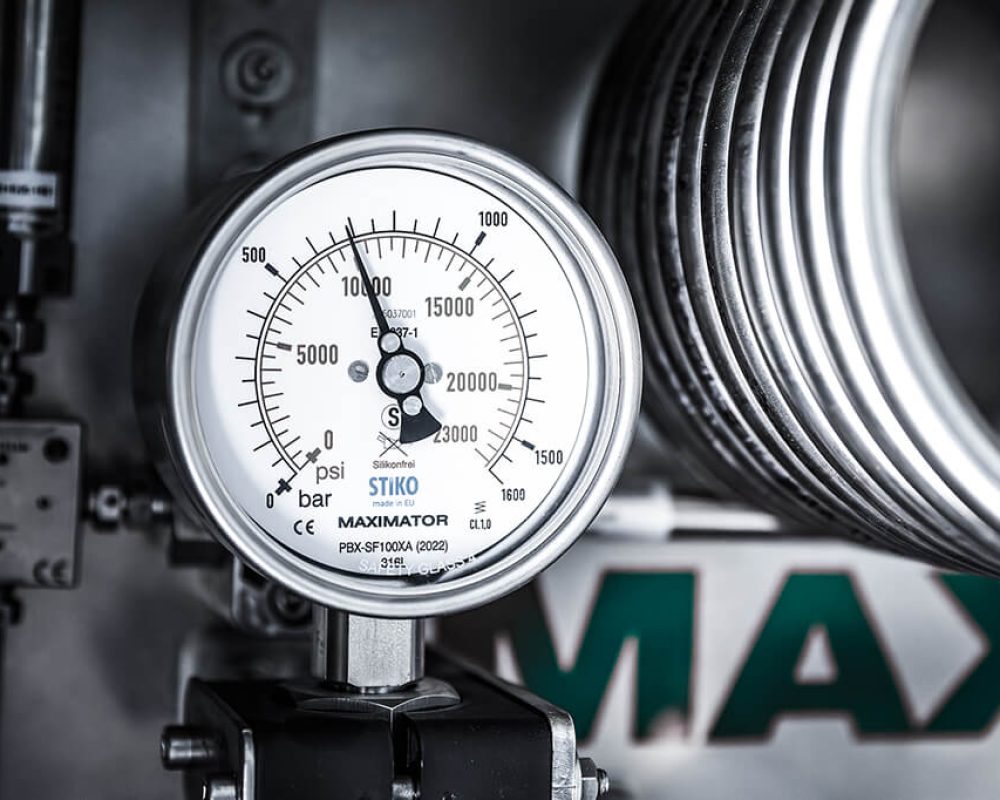
Deep-sea Simulator
A deep-sea simulator is a state-of-the-art pressure chamber that precisely replicates the extreme water pressures found in the deep sea. This technology is essential for the development and testing of offshore equipment, submarine components, and deep-sea sensors. We simulate ascent and descent processes to ensure the stability of materials and structures under realistic conditions. This allows us to reliably identify weak points and prevent material failure before it becomes critical.
Discover success stories relating to inspection and test systems
Find out how companies use aprotec’s testing and inspection systems to ensure the quality of their components and reliably validate their processes. These real-world examples demonstrate how specific requirements are met and test procedures are designed efficiently – let them inspire you in your own projects.
Test- and Inspection System
- Test- and Inspection System
- • Automotive
Helium Leak Testing System
Test- and Inspection System
- Test- and Inspection System
- • Subsea
Deep-Sea Simulator
Test- and Inspection System
- Test- and Inspection System
- • Semiconductor
WaferVision HSM-200
Test- and Inspection System
- Test- and Inspection System
- • Automotive
Helium Leak Testing System
- 8 s helium leak detection cycle time per component
- 10⁻⁶ mbar·l/s detectable leak rate (helium)
- 5 bar test pressure with 10% helium
Zone Melting System
Industry Solutions
We Develop Solutions Tailored to Your Industry
Get Expert Advice
Do you have questions or are you unsure which system is the right fit for your requirements? No problem. We are happy to advise you personally and work with you to find the ideal solution for your application. Benefit from our years of experience, an honest assessment, and professional guidance — tailored to your needs and with no obligation.
Contact person
Michael Landgraf
Managing Director
- m.landgraf@aprotec-gmbh.de
- +49 9353 982460-11